Ask your AI Chat What You Should Delegate to AI

You probably already ask AI for help.
You paste in a messy note and ask for a cleaner version. You upload a meeting transcript and ask for the important points. You give it a half-finished draft, a planning problem, some customer , or a decision you do not want to think through alone.
AI gives you a summary, a better draft, a few options, or the next step.
That is useful.
But it is not really delegation yet.
You are still bringing AI one at a time. Every time the work comes back around, you gather the information, explain the situation, describe what “good” looks like, and guide the AI through the same process again.
Delegation is different.
Delegation means teaching AI enough about a repeated kind of work that next time, you do not have to start from zero.
The harder question is figuring out what you should delegate in the first place.
One surprisingly useful way to answer that is to ask the AI that has already been watching you work.
The Work You Repeat Is Hard to See
Repeated work becomes almost invisible.
Maybe every Monday you turn notes into a project update. Maybe every new client requires the same research. Maybe you repeatedly ask AI to rewrite emails because the first version is too formal. Maybe every article starts with you explaining the same audience, tone, structure, and formatting .
Because you are used to doing these things, they do not always feel like workflows.
They just feel like work.
AI can help spot those patterns, especially if it has access to enough of your previous context.
ChatGPT, for , has a Memory feature that can retain useful information about you between conversations. OpenAI currently separates this into saved memories and information referenced from previous chats, depending on your settings and plan.[1]
Claude also has memory features, although how they work differs by product. Anthropic recently updated memory in Claude so it can maintain categorized information across conversations, while Claude Code has its own project-oriented memory system.[2]
The important point is not which menu you click.
The useful part is giving AI enough history to recognize patterns.
Use Memory as a Delegation Mirror
Most people think of as .
The AI remembers what you do, how you like things written, what projects you are working on, or other useful details.
That is helpful, but there is another use.
Ask it to study your patterns.
Instead of asking:
“What can AI automate for me?”
ask:
“Based on what you know about how I work, what am I still doing manually that I should be delegating to AI?”
That small change matters.
The first question tends to produce generic suggestions like email, research, scheduling, and writing.
The second question forces the AI to look for evidence in your actual behavior.
Maybe you constantly rebuild the same project context.
Maybe you ask for five versions of the same type of customer response.
Maybe you repeatedly turn unorganized notes into structured documents.
Maybe you gather information manually, then bring it to AI only after the expensive part of the work is already finished.
Those are much better delegation candidates.
Try This Prompt
Use this in an AI tool that has enough memory or history to understand how you work:
From what you remember about me, my work, my recurring projects, and the things I repeatedly ask you to help with, where am I using AI too small?
What work should I be delegating to AI that I am still doing manually, carrying myself, or handling one chat at a time?
Do not give me generic productivity advice.
Look for evidence in my actual behavior, including work I keep re-explaining, projects I restart from scratch, research or administrative work I avoid, decisions I keep revisiting, drafts I repeatedly reshape, formats I request often, context I keep pasting, standards I repeatedly correct, and work AI could prepare before I make the final decision.
Give me 10 delegation candidates.
For each candidate, explain the work I should delegate, the pattern you noticed, why it matters, what AI could prepare or handle, what I should still own, and the best first prompt for delegating it.
The most important sentence is:
“Use evidence from my actual behavior.”
Without that instruction, you may get a list that could apply to anybody.
With it, you are asking the AI to perform a small audit of how you work.
Do Not Automate All 10
If the AI gives you ten good ideas, resist the temptation to build ten systems.
Pick one.
A good first candidate is something that happens regularly, follows roughly the same process, and requires preparation before you make the final decision.
Then ask AI to turn it into a repeatable workflow.
You can say:
I want to delegate candidate number 3.
Turn this into a repeatable AI workflow.
Tell me what AI should do each time, what context it needs, what I should provide, what output it should produce, what I should review, what I should continue to own, and what reusable asset would work best.
Then create that reusable asset for me.
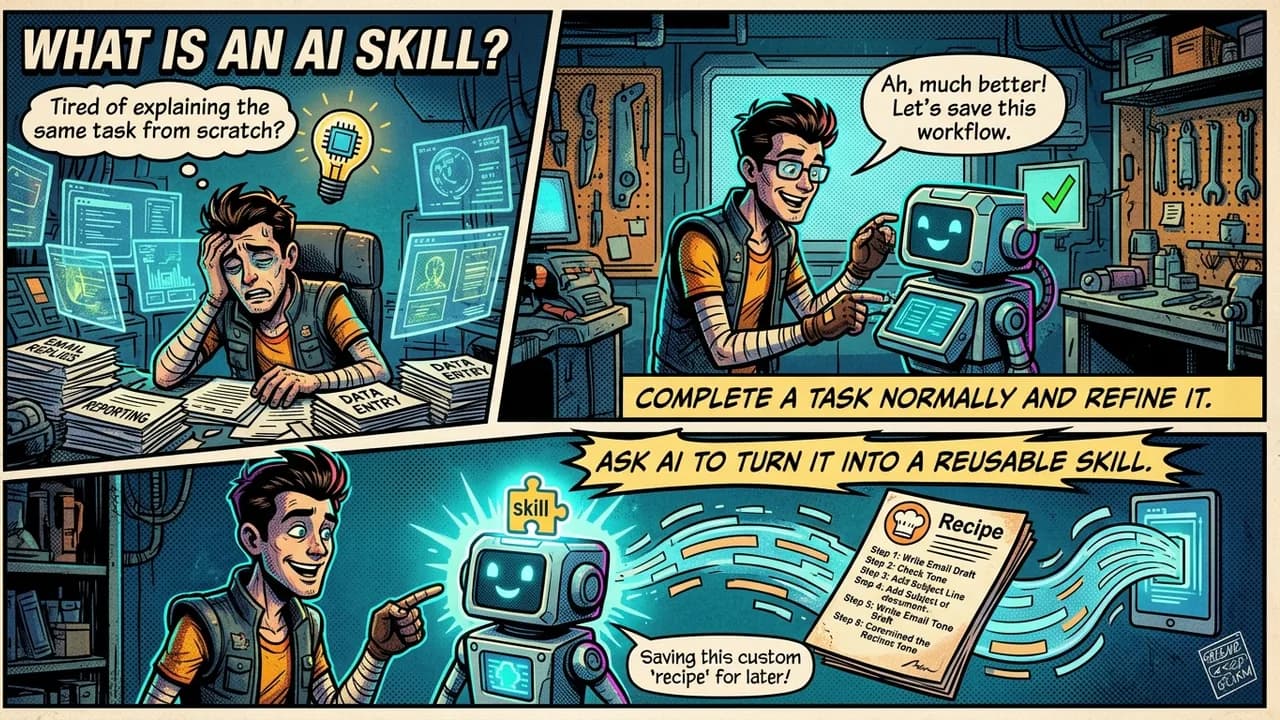
That reusable asset might be a , project template, memory instruction, specialized sub-, or an AI skill.
A skill is a reusable workflow that gives an AI specific instructions for completing a type of task consistently. Current versions of both ChatGPT and Claude support skills built around SKILL.md files, which can contain instructions and, in more advanced cases, supporting files, scripts, examples, or other resources.[3][4]
You do not need that level of sophistication for every task.
Sometimes a good reusable prompt is enough.
Keep Yourself in the Important Parts
Delegation does not mean handing over every decision.
A useful rule is to delegate preparation before judgment.
AI can organize the notes. You approve the conclusion.
AI can prepare the customer response. You decide whether to send it.
AI can research the options. You choose one.
AI can summarize the contract. A qualified professional handles the legal decision.
AI can prepare a weekly report from the underlying data. You decide what matters and what action to take.
This distinction becomes increasingly important as AI systems gain more and autonomy.
The goal is not to remove yourself from your work.
The goal is to stop spending human on parts of the process that do not require human judgment.
Start With the Thing You Keep Explaining
Look at your last few weeks of AI conversations.
There is probably something you have explained more than once.
That is the first place to look.
Maybe you keep telling AI how to structure your reports.
Maybe you paste the same company background into every new conversation.
Maybe you always correct the same writing habits.
Maybe you gather the same information before making the same type of decision.
Whatever it is, do not just ask AI to do it again.
Ask AI why you are still doing so much of it yourself.
Then take one repeated piece of work and turn it into a process the AI can prepare for you next time.
Your AI should not only remember who you are.
It should help you notice the work you no longer need to carry by hand.
Sources & References
[1] OpenAI. Memory FAQ and How does “Reference saved memories” work? OpenAI Help Center.
[2] Anthropic. Claude Release Notes and How Claude remembers your project. Anthropic documentation.
[3] OpenAI. Skills in ChatGPT and Using Skills. OpenAI Help Center and OpenAI Academy.
[4] Anthropic. What are Skills? and Extend Claude with Skills. Anthropic Help Center and Claude documentation.