AI Hallucinates Sometimes. Here's How to Spot When It Does.
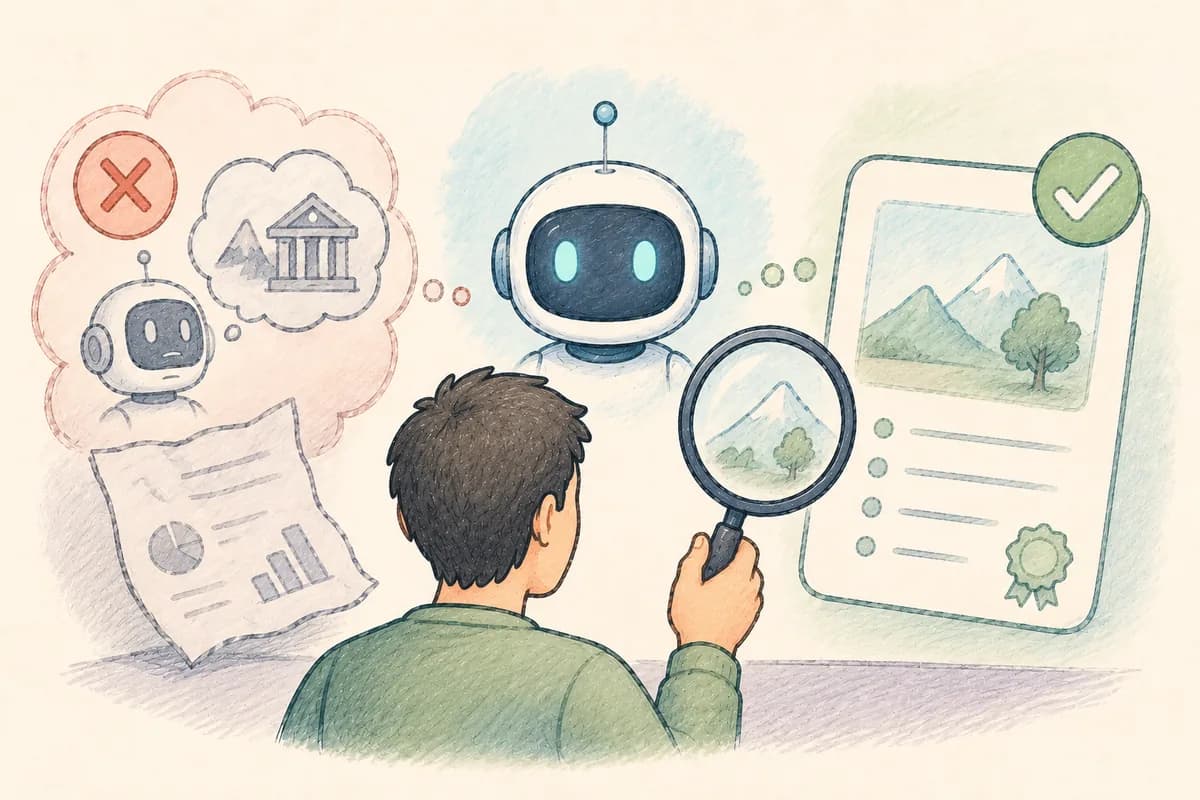
An AI tool will tell you, in perfectly confident prose, that a study from Stanford found a 34 percent improvement, that a court ruled on a case in 2019, or that a book by a real author contains a chapter that does not exist. It will sound exactly as sure of the fake answer as the real one. That is the problem with AI : there is no tell in the tone. The tells are somewhere else, and once you learn them, you can catch most fabrications before they cost you anything.
Red Flag One: "Research Shows"
Start with the easiest tell to spot: vague attribution.
Phrases like "research shows," "studies have found," "experts agree," and "it is widely known" sound authoritative and mean almost nothing. When an AI actually has a real source behind a claim, it can usually name it. When it does not, it reaches for these fog phrases, because they are the pattern human writers use when hand-waving, and the AI learned the pattern.
Vague attribution does not guarantee fabrication, but it is often the fingerprint of it. Treat every "research shows" as an unsupported claim until proven otherwise. A useful reflex: whenever you see one, ask "which research, specifically?" The answer, or the lack of one, tells you a lot.
Red Flag Two: Suspiciously Specific Details
The second tell is the opposite of vagueness: precision that arrives without .
Specific numbers, exact dates, and formal are red flags when they show up unsupported. "Adoption grew 47 percent in 2021." "The policy took effect on March 12, 2018." "See Henderson v. Callow, 2019." These details feel like the most trustworthy part of an answer, and that instinct is exactly backwards. Specifics are where AI is weakest, because precise facts are thin in its data, and it fills the gap by generating a number or citation that looks like the kind of thing that belongs in the sentence.
Fabricated citations deserve special caution. AI can produce a fake study with a plausible title, real-sounding authors, a real journal name, and a page range. Everything about it checks out except its existence. Lawyers have been sanctioned in real courtrooms for filing briefs with AI-invented case citations they never verified. If a citation matters, confirm the source exists before you rely on it, every time.
The Cross-Examination Test
Red flags help you spot suspicious claims. Cross-examination helps you test them.
The technique is simple: ask the same question again, worded differently, ideally in a fresh . If the AI actually has solid for an answer, the answer stays stable across phrasings. If it is fabricating, the story tends to drift. The percentage changes. The date moves. The study gains a different author. A real memory survives rephrasing; an invention gets re-invented each time.
You can also press directly: "Are you certain about that statistic? What is the original source?" Modern will sometimes walk a claim back under scrutiny, which is itself the answer you needed. An expert whose facts change every time you rephrase the question is not an expert you cite.
Why This Happens (and Why It Won't Fully Stop)
Here is the part most people miss: hallucination is not a bug that slipped through testing. It is inherent to how language models work.
A large generates text by predicting likely words, one after another, based on patterns learned from massive amounts of writing. Likely is not the same as true. The model is not checking a fact database before it speaks; it is producing the most plausible-sounding continuation of the sentence. Most of the time, plausible and true overlap, because the training data is mostly accurate. When they diverge, the model picks plausible, confidently, because confidence is also a pattern it learned.
This explains the uncomfortable truth about the fix. The solution is not waiting for smarter models. Newer models hallucinate less often, and that trend will continue, but a system built on predicting likely text will always be capable of predicting likely fiction. Less frequent is not never, and a rarer hallucination is arguably more dangerous, because your guard drops. The fix lives on your side of the screen: practices and audit trails, meaning you keep track of which claims came from AI and which have been independently confirmed.
Shrink the Problem With Better Prompts
While verification is your safety net, better shrinks the number of hallucinations you have to catch in the first place. Three habits make a measurable difference:
- Specify date ranges. "What were the major developments in this area between 2020 and 2023?" gives the model and reduces its temptation to blend eras or invent recent events.
- Request verifiable sources. Ask it to name sources you can check, and tell it that "I don't know" or "I can't verify this" are acceptable answers. Giving the model explicit permission to admit uncertainty reduces its pressure to fill gaps with fabrication.
- Name trusted organizations. "According to the CDC" or "based on IRS publications" anchors the response to a specific body of information instead of the model's general soup of patterns.
These habits do not eliminate hallucination. They reduce its frequency and make the remaining claims easier to verify, because you have already defined where the answers should come from.
The Non-Negotiable Rule
All of this rolls up into one rule: always fact-check AI-generated claims before using them in any context that matters.
Calibrate the effort to the stakes. Brainstorming dinner ideas needs no verification. A statistic going into a client presentation, a legal or medical claim, a number in a published article, anything with your name or money attached, gets checked against a primary source first. The thirty seconds it takes to confirm a claim is the cheapest insurance you will ever buy, and it is dramatically cheaper than explaining to a client, a boss, or a judge why you repeated something that was never true.
The Bottom Line
You cannot hear a hallucination in the AI's , but you can see it in the evidence. Fog phrases like "research shows" signal unsupported claims. Unsourced specifics, especially citations, are where fabrication concentrates. Rephrasing a question exposes answers that will not hold still. Good prompting, with date ranges, source requests, and named organizations, cuts the error rate before you start. And a simple verification habit catches what slips through. The models will keep improving. Your process is what makes them safe to use today.