How to Replace Your Google Search with Claude.ai
Think about what actually happens when you Google something confusing. You type "how does a HELOC work," get ten links, open three tabs, skim two articles written for nobody in particular, and close your laptop knowing slightly more than when you started. The information was out there. It just wasn't for you.
There's a better way to handle that entire category of search, the "explain this to me" search, and it's a with an AI tool like Claude.ai.
The Shift: From Query to Conversation
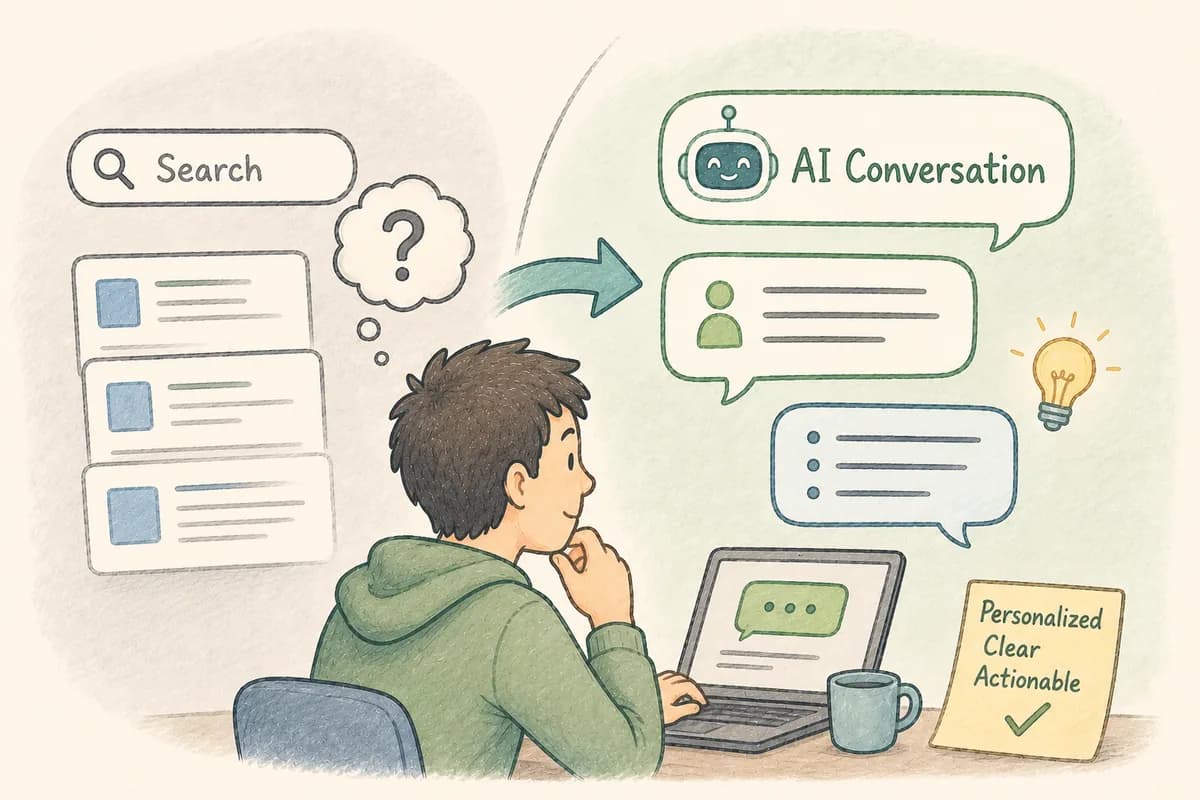
The core difference between a search engine and an AI tool isn't the answers. It's the shape of the interaction.
A Google search is a single- transaction. You ask once, you get links, and the conversation is over. If the results miss, you start over with new keywords, essentially re-rolling the dice.
An AI conversation is a back-and-forth exchange, and that back-and-forth is where understanding actually gets built. You ask, it explains, you say "wait, what about this part," it adjusts, you ask a follow-up, it goes deeper. Nobody learns anything complicated from one paragraph. People learn through exactly this kind of exchange, which is why a good teacher beats a good textbook. A multi-turn conversation with AI produces better understanding than any single search ever will, because the explanation keeps bending toward your confusion until it disappears.
Why AI Beats Search for Explanations
There's a second structural advantage: customization.
Every article Google returns was written before you asked your question, for a generic audience, by someone who has never heard of your situation. The article about HELOCs doesn't know you're comparing one against a cash-out refinance for a rental property. The article about Roth IRAs doesn't know you're 24 and just got your first salaried job. You have to read the generic version and do the translation to your life yourself. That translation step is where most understanding falls apart.
AI generates the explanation after hearing your situation, so the translation is built in. Tell it you're 24 with your first salaried job, and the Roth IRA explanation arrives pre-fitted: your tax bracket logic, your time horizon, your likely employer match question. Nothing generic to wade through, because nothing was written until you described yourself.
To be clear about the boundary: this advantage applies to explanations and understanding. For real-time facts like today's flight status or a current stock price, search still wins, and any AI-provided fact worth acting on should be verified, as covered in the article.
The Prompt Structure That Makes It Work
Getting this right takes one simple structure with two parts:
- Ask for a plain-language explanation. "Explain how a HELOC works in plain English."
- Add your personal in one or two sentences. "I own a rental property with about $120k in equity, and I'm deciding between a HELOC and a cash-out refinance to fund a renovation."
That second part is the entire trick. Two sentences of context transform the answer from an encyclopedia entry into advice-shaped explanation. The AI now knows what to emphasize, what to skip, and which comparison actually matters to you. Every "replace Google" prompt should carry those two pieces: the plain-English request and the personal frame.
Level Up: Ask for the Outcome, Not the Concept
Once the conversational habit sets in, there's a second gear: stop asking the AI to explain things and start asking it to help you achieve things.
"Explain how HELOCs work" is a concept question. "Help me figure out whether a HELOC or a cash-out refinance is the cheaper way to fund a $40k renovation on my rental" is an outcome question. The second version gets you a dramatically more useful response, because the AI organizes everything around your goal: the factors that matter, the numbers you need to gather, the decision logic, the questions to ask a lender.
Concept questions get you knowledge. Outcome questions get you a plan. Search engines were never capable of the second one at all, which is why this is where the replacement becomes obvious. You were never really searching for "how HELOCs work." You were searching for "what should I do." Now you can ask that directly.
When You're Still Confused, Don't Restart. Steer.
Here's where people trained on search engines make their one big mistake. When an AI explanation doesn't land, they treat it like a failed search: scrap it, rephrase the whole question, start over.
Don't restart. Steer. The conversation is still alive, and the AI can adjust its approach if you tell it where the problem is. The skill is naming exactly what's still unclear:
- "I understand the draw period, but I'm lost on how repayment changes after it ends."
- "The tax part made sense. Go back to the rate piece and use actual dollar amounts."
- "You're assuming I know what 'equity' means precisely. Define that first, then re-explain."
Each of these tells the AI precisely which part of its explanation failed, and it will rebuild that part differently: a new analogy, a concrete , a slower walkthrough. Compare that to Google, where "I didn't understand the article" has no move except reading a different article that fails in a new way. Naming your confusion is a skill worth practicing on its own. It's also, not coincidentally, how you'd get the most out of a human expert.
Putting It Together
Here's the full pattern on one screen:
"Explain [topic] in plain English. My situation: [two sentences of context]. What I'm ultimately trying to do is [goal]."
Then read the response and keep the conversation going. Name what's unclear. Push toward your decision. Ask "what am I not thinking about?" Five minutes of that exchange routinely beats forty-five minutes of tab-juggling, and you come out the other side with understanding fitted to your actual life instead of a browser history full of half-read articles.
The Bottom Line
Search engines hand you documents and leave the understanding to you. AI builds the understanding with you, shaped to your situation, refined by your follow-ups, and aimed at your actual goal. Keep search for real-time facts and things you need to verify. But for every "explain this to me" and "help me figure this out" moment, the tab you open should be a conversation, not a query.