What is AI? Do You Actually Understand It?
Most people use AI every day and still can't explain what it actually is. They type a question, get an answer, and move on. That works fine until the AI confidently tells you something completely wrong and you believe it. Understanding what's happening under the hood is the difference between using AI well and getting burned by it.
The Simple Version: Text In, Text Out
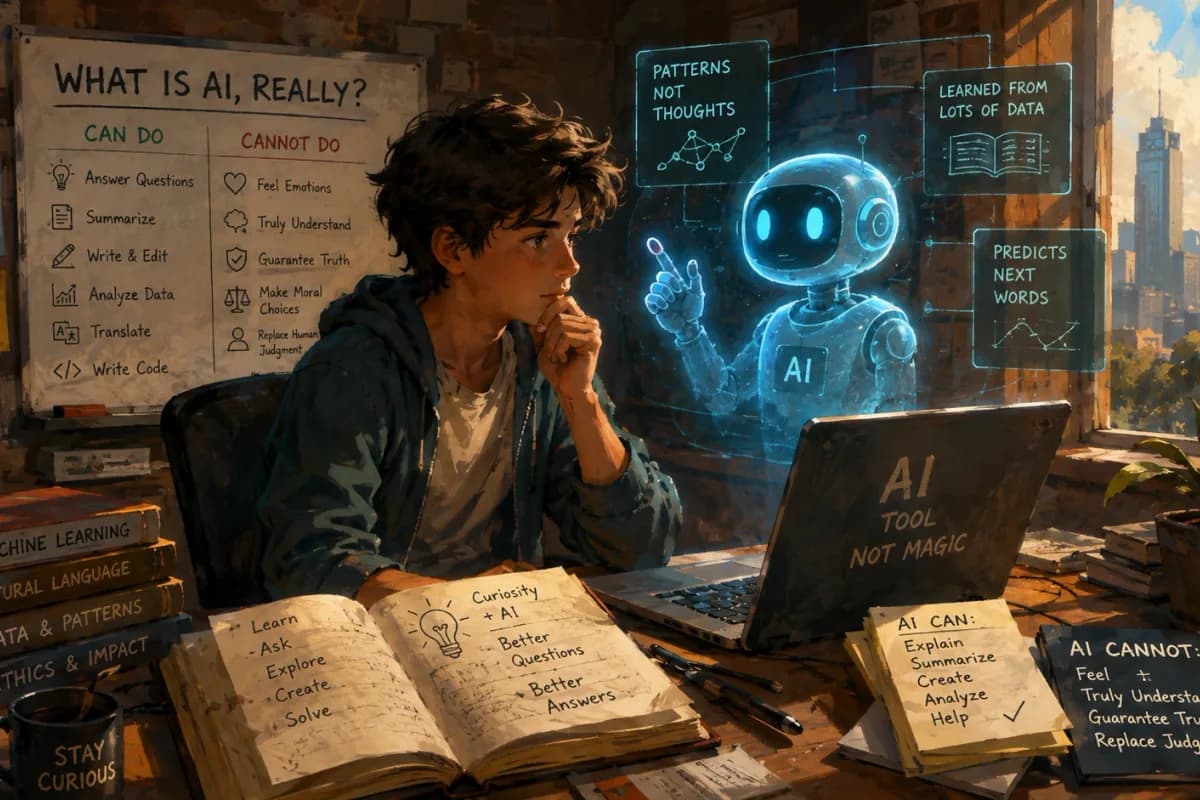
At its core, an AI system like ChatGPT, Claude, or Gemini does one thing. It reads text and generates text output in response. You type something, it types something back. That's the whole transaction.
What makes this interesting is how it decides what to type back. It's not looking up answers in a database. It's not searching the internet by default. It's doing something closer to prediction.
How It Learned to Talk
These systems were trained on enormous amounts of text. Books, articles, websites, conversations, forum posts, technical manuals, and just about anything else written down and digitized. We're talking about a scale of text no human could read in a thousand lifetimes.
During , the AI learned patterns. Not facts stored neatly in folders, but patterns. How sentences are usually built. What words tend to follow other words. How an argument is typically structured. What a recipe looks like versus what a legal contract looks like.
The technical name for this kind of software is a large , or LLM. That's the term you'll see everywhere: software trained on massive amounts of text that generates human-like responses.
Sophisticated Autocomplete
Here's the mental model that will serve you best: AI is sophisticated autocomplete.
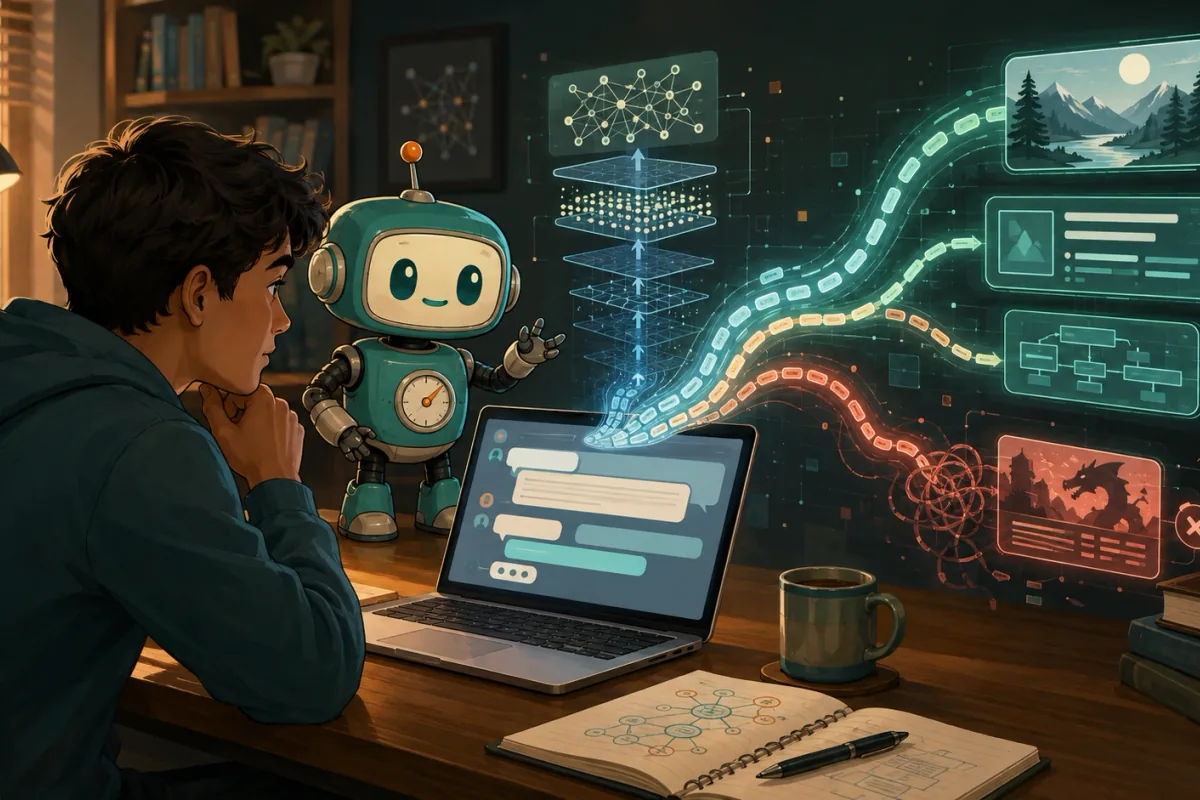
Your phone's autocomplete predicts the next word when you're texting. An LLM does the same thing, but at a much deeper level. It predicts responses one word at a time, based on all the patterns it absorbed during training. And it's not just predicting words. It's predicting ideas, structures, and entire arguments. It has learned what a persuasive essay looks like, so it can predict one into existence. It has learned what an apology email sounds like, so it can generate one on demand.
That word-by-word prediction happens so fast and so fluently that it feels like you're talking to something that "knows" things. But knowing and predicting are not the same, and that difference explains almost everything about where AI shines and where it fails.
Where It's Strong and Where It's Weak
AI produces strong output when the patterns are rich. There are millions of professional emails in its training data, so when you ask it to write one, it has a deep well of patterns to draw from. The result is usually excellent.
AI produces weak output when the patterns are thin. Ask it for a specific statistic, like the exact population of a small town in 2019, and it's in trouble. There may be very little training data about that exact fact, but the AI will still generate an answer, because generating answers is what it does. It will predict a number that looks like the kind of number that belongs in that sentence. Sometimes it's right. Sometimes it's not.
This is the single most important thing to understand about AI.
Hallucination: When AI Makes Things Up
There's a technical term for this failure mode: . A hallucination is when AI makes something up and presents it as fact. It can invent statistics, fake book titles, court cases that never happened, and quotes nobody ever said. And it presents these inventions with total confidence.
Here's the dangerous part. AI delivers wrong answers with the same confidence as correct ones. There's no stutter, no hesitation, no "I'm not sure about this." A completely made-up answer sounds exactly as reasonable and polished as a correct one. Wrong answers look identical to right answers.
The good news is that hallucinations happen less frequently than they used to. Modern AI are significantly more accurate than the versions from a few years ago. The bad news is that "less frequently" is not "never," and because wrong answers look identical to correct ones, you can't spot them by tone or style.
So How Should You Actually Use It?
This leads to a simple rule of thumb.
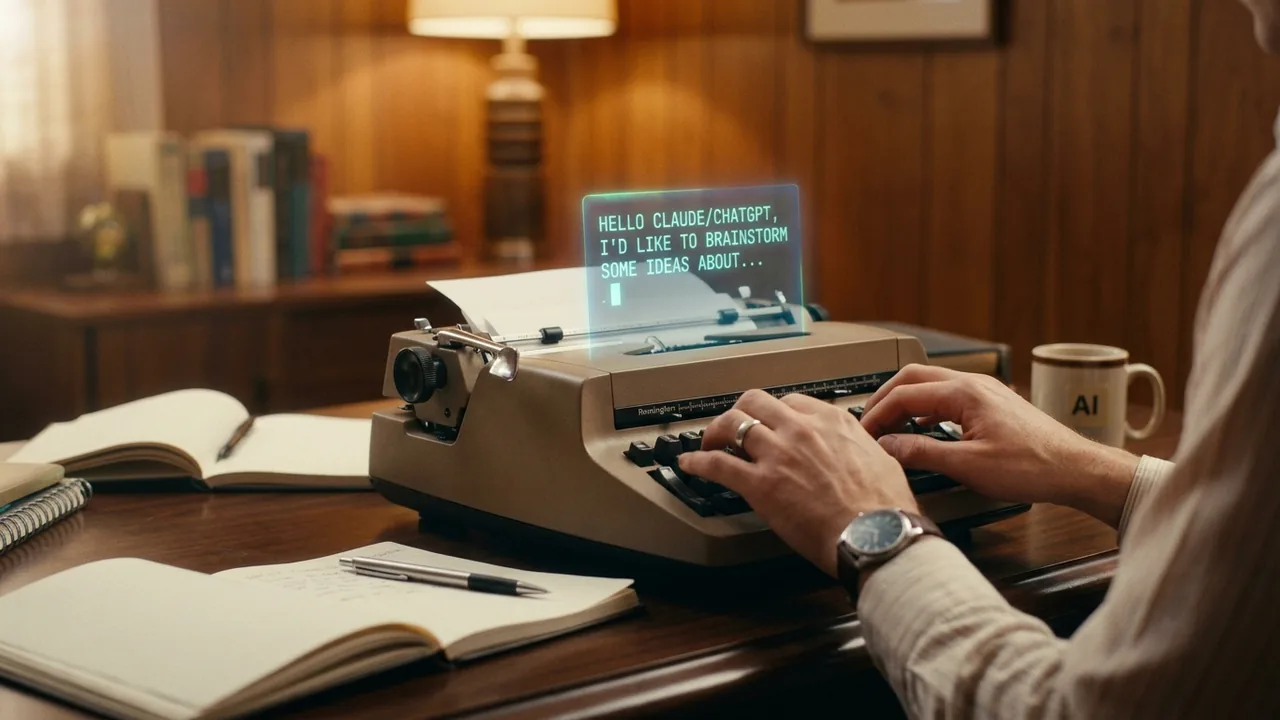
Use AI as a drafting partner for language tasks. This is where it excels. Rewriting a clunky paragraph, summarizing a long report, brainstorming ideas, drafting a message, explaining a complicated concept in plain terms. These are all pattern-rich language tasks, and AI is genuinely great at them. It's a generalist, comfortable jumping from a business email to a science explanation to a birthday poem in the same .
Only trust AI as a knowledge source for facts you can verify. If the AI tells you a fact and that fact matters, check it. Ask for a source and confirm the source exists. Treat AI-provided facts the way you'd treat something a smart but overconfident friend told you at a party. Probably right, worth confirming before you repeat it.
One of the most underrated uses of AI is learning. It can explain complicated topics effectively through conversation. You can ask a question, get an explanation, then say "explain that part again like I'm ten" or "give me an ." No textbook or video can adapt to you like that.
The Major Players
ChatGPT (from OpenAI), Claude (from Anthropic), and Gemini (from Google) are the major AI tools, and they're all built on similar foundations. All of them are large language models trained on massive text, all of them predict responses word by word, and all of them can hallucinate.
That said, different AI tools have different personalities and strengths. One might be better at coding, another at writing, another at analyzing long documents. The differences come from how each company trained and tuned its model. It's worth trying more than one to see which fits your work.
Getting Better Results: The Prompt
The you type into an AI tool is called a prompt. And here's a rule that will immediately improve your results: AI responds to specific instructions. The more specific your prompt, the more useful the result.
"Write an email" gets you a generic email. "Write a friendly two-paragraph email to a client explaining that their project will be delayed one week due to a supplier issue, and offer a call to discuss" gets you something you can actually send.
One more term worth knowing: the . This is the amount of information and text an AI tool can consider at one time. It includes your prompt, any documents you've shared, and the conversation so far. If a conversation runs extremely long, the earliest parts can fall outside that window, which is why AI sometimes seems to "forget" things you said earlier.
The Bottom Line
AI is a prediction machine trained on a huge slice of human writing. It's a phenomenal drafting partner, a capable explainer, and a tireless brainstormer. It is not an infallible source of truth. Use it for language, verify it for facts, be specific in your prompts, and you'll get real value out of it while avoiding its biggest trap: an answer that sounds perfect and happens to be wrong.