A Beginner’s Guide to AI Without the Hype
Artificial intelligence is suddenly everywhere.
Your phone has AI. Your car has AI. Your email has AI. Every software company seems to have added an AI button somewhere, and depending on which headline you read, AI is either about to solve humanity’s biggest problems or take everyone’s job before lunch.
The reality is much less dramatic, and much more interesting.
Artificial intelligence, or AI, is a broad term for computer systems designed to perform tasks that normally require some form of human intelligence. That can include recognizing objects in a photograph, understanding language, making predictions, finding patterns, recommending what movie you might like, or generating entirely new text, images, audio, and video.
The National Institute of Standards and Technology, or NIST, defines an AI system broadly as a machine-based system that can generate outputs such as predictions, recommendations, or decisions for a given set of objectives.[1]
That definition is useful because AI is not one specific program or technology. It is a large family of technologies.
You Have Probably Been Using AI for Years
If you have never opened ChatGPT or Claude, you might think you have never used AI.
You probably have.
When Gmail decides that a belongs in your spam folder, automated systems are analyzing patterns to help make that decision. When Netflix recommends another crime documentary because apparently three murders were not enough for one evening, recommendation algorithms are trying to predict what you might watch next.
Navigation apps analyze enormous amounts of information to estimate travel times and recommend routes. Smartphones can recognize faces in photographs. Banks use automated systems to detect unusual transactions. Online stores recommend products based on patterns in shopping behavior.
These are all examples of AI or closely related systems.
Machine learning is a branch of AI in which computers learn patterns from data rather than having a programmer manually write a rule for every possible situation.
Imagine trying to create a spam filter the old-fashioned way. You could write a rule saying, “If an email contains the phrase ‘YOU WON $10 MILLION,’ send it to spam.”
That works until the scammers change the wording.
A machine learning system can instead examine large numbers of spam and legitimate messages and learn patterns that tend to distinguish one from the other.
So What Changed With ChatGPT?
For decades, much of the AI we encountered operated quietly behind the scenes.
Generative AI changed that.
Generative AI is AI designed to create new content, such as text, images, computer code, music, audio, or video.
such as ChatGPT and Claude made generative AI accessible through something almost everyone already understands: a .
Instead of learning a programming language, you can simply type:
“Explain how a mortgage works.”
Or:
“Help me plan meals for five people this week.”
Or:
“Turn these meeting notes into a professional summary.”
That simple interface hides an extremely complicated system underneath.
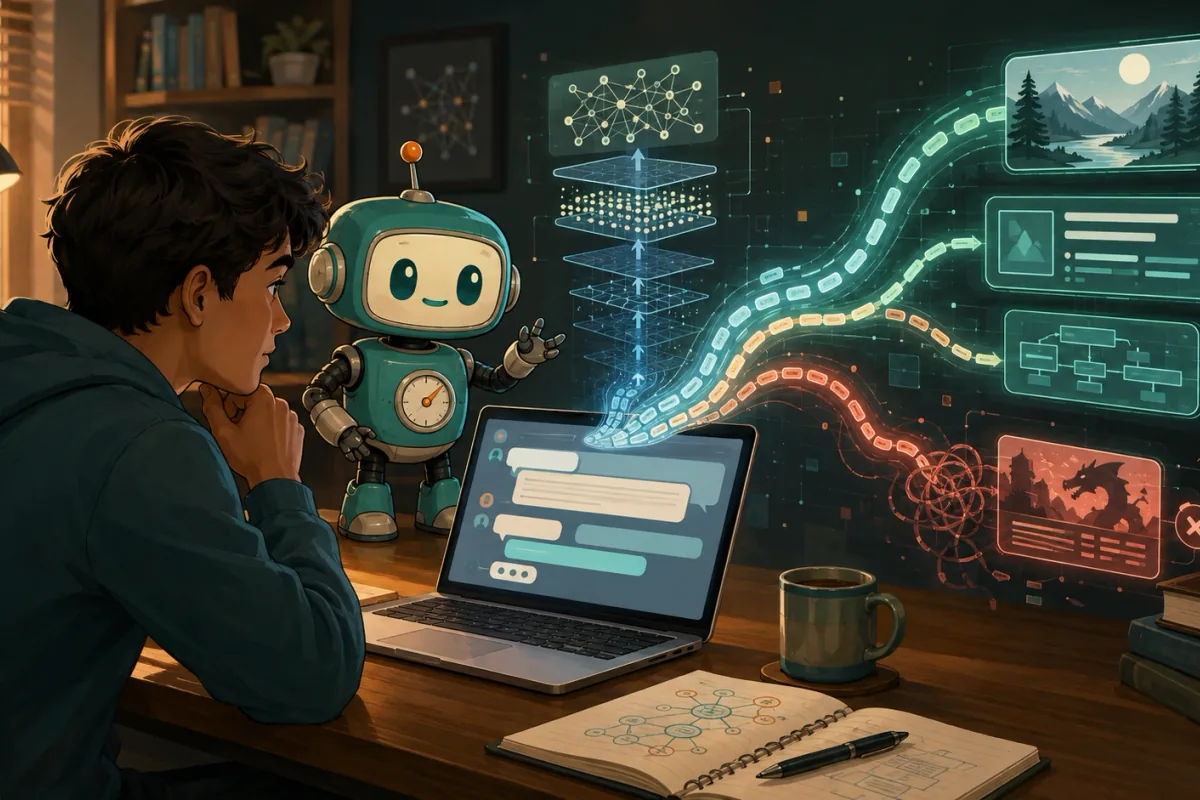
ChatGPT and Claude are built around large language models, commonly shortened to LLMs. These models are trained using enormous amounts of text and learn statistical relationships among pieces of language.
Text is broken into smaller units called . A token might represent a word, part of a word, punctuation, or another small piece of text.[2]
During their initial , language models learn to predict what token is likely to come next. Anthropic describes its language models as first being pre-trained as next-token predictors before additional training teaches them how to behave as useful AI assistants.[3]
This sounds surprisingly simple considering the results.
If I write:
“The dog chased the...”
You can probably guess that words like “ball,” “cat,” or “squirrel” are more likely to follow than “refrigerator legislation.”
Language models perform a vastly more sophisticated version of this prediction using patterns learned during training. Modern systems can use those learned patterns to explain ideas, write software, analyze documents, work with images, solve many types of problems, and carry on surprisingly natural conversations.
What Can Modern AI Actually Do?
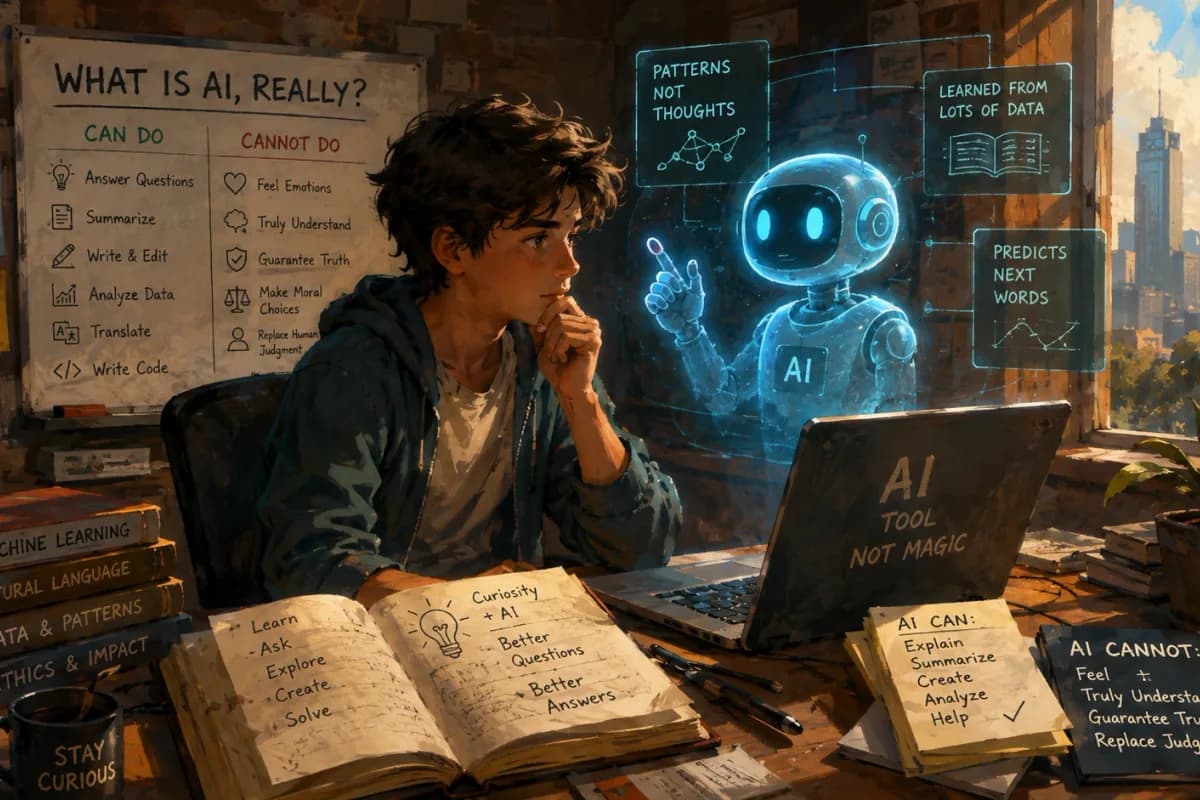
Current AI is very good at working with information.
Give it a long report and it can summarize it. Give it a badly written paragraph and it can rewrite it. Ask it to explain photosynthesis as if you were 12 years old and it can adjust the explanation.
It can compare products, brainstorm business names, analyze spreadsheets, translate languages, create study materials, generate computer code, extract information from documents, and help organize complicated ideas.
Many current AI systems are also , meaning they can work with more than one type of information. Modern models can accept combinations of text and images, and AI systems more broadly can generate or process audio, images, and video as well.[4]
AI systems are also increasingly capable of completing multi-step tasks when they are connected to external tools. An , for , might be allowed to search the web, inspect files, run software, or interact with other applications.
The capabilities are advancing quickly. Stanford’s 2026 AI Index reports continued significant improvement across areas such as language, reasoning, mathematics, and coding, while also noting that evaluating these rapidly changing systems is becoming increasingly difficult.[5]
That does not mean AI has become an electronic human.
What Can AI Not Do?
This is where much of the hype causes confusion.
A confident answer from an AI is not automatically a correct answer.
Language models generate responses based on patterns, probabilities, their training, their instructions, the information you provide, and sometimes external tools. They can produce information that sounds completely reasonable but is incorrect.
These incorrect invented details are commonly called hallucinations.
An AI might provide the wrong date, misunderstand a document, invent a source, make a mathematical mistake, or confidently explain something that never happened. The fact that the answer is beautifully written does not make it true.
AI also does not automatically know everything happening in the world right now. Whether it has current information depends on the specific system and whether it has access to tools such as web search, databases, or connected applications.
It cannot automatically access your computer, email, bank account, or private documents simply because you ask it to. Those capabilities require specific tools, permissions, and connections.
AI also should not be treated as the final authority for important medical, legal, financial, safety, or other high-stakes decisions. NIST specifically emphasizes that AI systems introduce risks that need to be measured and managed rather than assuming the technology is automatically reliable.[1]
Perhaps most importantly, sounding human is not the same thing as being human.
Researchers are actively studying what kinds of internal representations and reasoning processes advanced language models develop, and there is still significant scientific debate about how best to characterize those processes. What we can say more safely is that an AI assistant does not have the same body, life experience, relationships, senses, and continuously lived understanding of the world that you do.
Think of AI as a Tool, Not an Oracle
A calculator is extremely good at arithmetic, but nobody asks a calculator whether they should marry their boyfriend.
AI is much broader and more flexible than a calculator, but the same basic principle applies.
It is a tool.
The useful question is not, “Is AI intelligent?”
A better question is:
“What is this particular AI system good at, what information does it have, and how much should I trust its answer for this particular ?”
Sometimes AI should provide the final answer. Sometimes it should provide a first draft. Sometimes it should help you explore possibilities. Sometimes its work needs to be carefully verified by a human.
Learning that difference is one of the most important skills you can develop as an AI user.
You do not need to understand mathematics to start benefiting from AI, just as you do not need to understand an internal combustion engine to drive a car.
Start by understanding what the tool can do, what it cannot do, and when you should check its work.
The rest gets much easier from there.
Sources & References
[1] National Institute of Standards and Technology. Artificial Intelligence Risk Management Framework and AI Resource Center.https://airc.nist.gov/airmf-resources/airmf/0-ai-rmf-1-0/
[2] OpenAI. How ChatGPT and Our Foundation Models Are Developed and What Are Tokens and How to Count Them?https://help.openai.com/en/articles/7842364-how-chatgpt-and-our-language-models-are-developedhttps://help.openai.com/en/articles/4936856-what-are-tokens-and-how-to-count-them
[3] Anthropic. A Global Workspace in Language Models.https://www.anthropic.com/research/global-workspace
[4] OpenAI. Models and Multimodal Capabilities Documentation.https://developers.openai.com/api/docs/models
[5] Stanford Institute for Human-Centered Artificial Intelligence. 2026 AI Index Report.https://hai.stanford.edu/ai-index/2026-ai-index-report