Build Your AI Org Chart: From Founder-Doer to CEO-Delegator

From To-Do Lists to Org Charts: How One Founder Automated His Company
Imagine you're a solo founder. Your week disappears in a blur. You research prospects, write content, send emails, and analyze data. You spend more time managing tasks than executing your vision. Your to-do list is a monster, and it's winning. This was the daily reality for a founder named Ridark, who recently described a powerful experiment on a social media platform.
He took a tool many people used as a simple chatbot—Grok Bot—and transformed it. He built an automated organization chart. In one week, he moved from being the primary worker to being a true manager. He delegated work to a team of AI "employees" he trained himself. The results were significant. He verified hundreds of prospects, drafted dozens of personalized outreach emails, and maintained an empty inbox.
This guide is not about getting better answers from a chatbot. It's about a fundamental shift in thinking. You must move from a reactive, -based approach to a proactive, outcome-driven system of delegation. Build a framework where you manage the what and the why, and a team of specialized AI agents handles the how. This is the real power of modern AI.
The Core Mindset Shift: Outcomes Over Tasks
The critical first step is to abandon your to-do list. When you interact with a powerful AI as a personal assistant, you remain the bottleneck. You still figure out every step, every question, and every follow-up. You are micromanaging a machine.
“I gave it outcomes, never tasks.”
This is the central idea from Ridark's original post. You must stop giving tasks. Start giving outcomes. Instead of saying "draft a LinkedIn post," you say "increase our qualified lead by 20 this week." Instead of "analyze last month's traffic," you say "identify the single biggest opportunity to improve our conversion rate."
The difference is profound. A task is a single action. An outcome is a result. When you command a single AI with a task, you get one action back. When you command a system with an outcome, it plans. It breaks the goal down into parts. It delegates those parts. It executes a sequence of actions to achieve the final result. You stop being a micromanager. You start being a chief executive. Your role transforms from doer to strategist.
Building Your AI Org Chart: The Essential Roles
Ridark's system is built on specialized "bots" or agents. Each has a clear, singular purpose. Think of them as your department heads. They report to a central coordinator. Here is how you can structure your own core team, inspired by this model. Start with these six roles.
Your Chief of Staff (Atlas)
This is your primary point of contact. It is the linchpin of the entire operation. You communicate only with this agent. Its job is to take your high-level outcome—like "We need to launch the beta waitlist next quarter"—and break it into specific projects. It then delegates those projects to your specialist agents. It manages a group chat for each major outcome. It ensures tasks are handed off smoothly. Crucially, the Chief of Staff never does specialist work. It only coordinates, reports status, and escalates true blockers to you. Blockers are things like irreversible decisions or spending money.
The Research Analyst (Scout)
This agent handles discovery and qualification. Give it your Ideal Customer Profile. Its job is to search the web, social media, and databases. It finds and vets potential leads. The key is it not to guess. As Ridark specified, if it cannot verify a piece of information, it must mark it as "unverified." A good Scout delivers a daily shortlist of highly qualified prospects. Each entry should include a one-line explanation of why this prospect is a perfect fit right now.
The Content Creator (Quill)
Content creation is a massive time sink. This agent your company's weekly learnings, wins, and insights into a content pipeline. It can generate social media posts, blog drafts, and newsletter outlines. All output should be in your unique . The trick is to provide it with examples of your previous writing. Give it your last 50 emails or social posts. This helps it mimic your style. A key rule: Quill only creates drafts. It never publishes anything autonomously. You keep final approval control.
The Outreach Specialist (Pitch)
Once Scout has a list of verified prospects, Pitch takes over. Its role is to craft concise, personalized first-touch messages and follow-up sequences. Ridark set a strict rule: 60 words maximum. This forces hyper-. Each should contain one specific observation about the prospect's business and one clear, non-spammy ask. These drafts should be queued in your email or CRM software. They are ready for you to approve in bulk with one click.
The Operations Manager (Vault)
Email and notification overload is a modern plague. Vault acts as your AI-powered executive assistant. It triages all incoming communications. It sorts them into three simple buckets: "Needs Me," "Needs a Bot," and "Needs Nothing." It handles the last category completely, dealing with things like calendar invites or spam. It routes the "Needs a Bot" items to the appropriate specialist agent. It summarizes the "Needs Me" items into a concise, five-bullet morning digest for you.
The Data Analyst (Ledger)
We drown in dashboards but thirst for insight. Ledger's job is to cut through the noise. Every night, it analyzes your key metrics. This includes website traffic, conversion rates, and sales figures. It delivers one simple report. It should highlight what moved significantly and what did not. Most importantly, it must state the single number you should care about tomorrow. No complex graphs. No fluffy adjectives. Just focused, actionable intelligence.
The Wiring: How Your Agents Communicate and Collaborate
A team of brilliant specialists is useless if they work in isolation. The architecture of communication makes this system hum. You need clear protocols.
- Group Chats per Outcome: Do not create a separate chat for each bot. Instead, create a dedicated group chat for each major company outcome or project. : "Q3 Lead Gen Blitz." Your Chief of Staff is a member of all these chats. You assign the outcome to the chat. Atlas then coordinates with the relevant specialists inside that single space.
- Visible Handoffs: All task delegation and completion happen inside these group chats. When Scout finishes its prospect list, it posts the list in the "Lead Gen" chat and Pitch. You, as the human, only need to skim the chat history to see the handoff occur. You are not managing the process minute-by-minute. You are auditing the workflow.
- Clear Charters with : Each bot must have a written "charter." This is a clear definition of its role, responsibilities, and—critically—its limits. Ridark emphasized a final, hard line for each charter: "Never do this without asking." For Quill, it ends with "Never publish without human approval." For Pitch, it might be "Never send an email from a human account without approval." These guardrails prevent chaos and build essential trust in the system.
Training Your Team: Show, Don't Just Tell
You cannot just describe a complex workflow to an AI and expect perfect execution. Written instructions are often ambiguous. The most effective training method is direct demonstration. It is faster and creates better results.
- Record Your Screen: Choose a real-world task and perform it from start to finish. For example, open your CRM. Find a qualified prospect. Research their company. Craft a personalized email. Queue it in a draft folder. Record your entire screen during this process.
- Narrate Your Process: As you perform the task, explain your decision-making out loud. Say things like: "I'm looking for a recent product launch mention because it shows they're in growth mode. I'm avoiding generic compliments. I'm keeping this under 60 words because longer emails get ignored. I'm saving this as a draft because I want to review all outreach together."
- Feed the Recording: Provide this screen recording and its transcript to the relevant agents. For the email example, give it to both Scout and Pitch. This single, contextual demonstration teaches them more about your standards, , and nuance than a hundred written instructions could. It embeds your operational knowledge directly into the AI's understanding.
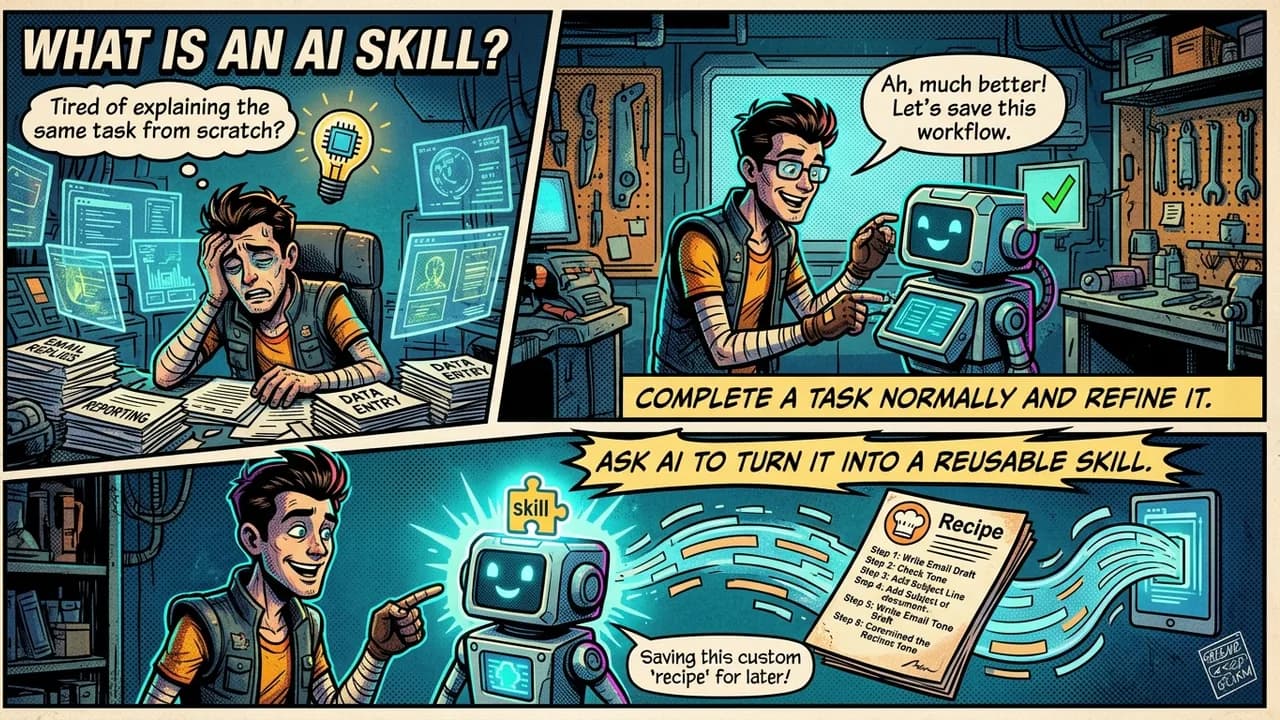
This "show once" method, which Ridark highlighted, is a key rule for effective AI agent training. It transfers your tacit knowledge.
Your First Week Implementing the System
Implementing this does not require a massive, overnight overhaul. Start small. Build momentum with quick wins.
First, appoint your Chief of Staff. Choose your most capable AI interface—like Grok Bot or a similar advanced model. Begin by giving it only outcome-based instructions for one area of your business. Say, "This week, I need 10 qualified leads for our consulting service."
Next, build just one specialist. Start with the role causing you the most daily pain. Maybe it is Vault for achieving inbox zero. Or Quill for content creation. Train it thoroughly using the screen-record method for one specific, repeatable task. Then, integrate it into a group chat with your Chief of Staff. Name the chat after the outcome.
Now, resist the powerful urge to micromanage. Let the Chief of Staff break down the outcome. Watch it delegate the first task to your new specialist. Observe the handoff happen in the chat. Your job is to provide feedback on the final output, not to dictate the process. Is the prospect list high-quality? Is the email draft good? Judge the result.
Within a few days, you will feel a shift. You will start your morning not with a daunting list of tasks, but with a digest of what was accomplished overnight. You will have a clear priority for the day. You will spend your mental energy on strategic decisions and creative problems, not on repetitive execution. You will begin to feel like a manager of a capable team.
The New Bottleneck: Your Clarity and Vision
The promise of this system is not a life of idle leisure. It is a life of leveraged focus. The bottleneck is no longer how much you can do personally. The new bottleneck is how clearly you can define what needs to be achieved. Your value shifts from pure output to vision, strategy, and judgment.
The AIs handle the how. You must master the what and the why. This is the real power of modern AI—not as a conversational tool, but as the foundational layer for a scalable, automated, and intelligent operational framework. It turns one person into a formidable team. It allows a solo entrepreneur to operate with the leverage of a small company.
The future of solo entrepreneurship, small team leadership, and even corporate management is not about working harder alongside AI. It is about learning to build, train, and lead with it. Your first outcome is waiting. What will you delegate first? Choose one pain point this week. Build one agent. Start the shift from founder-doer to CEO-delegator.